What Celebrity Do I Look Like? Find Out from One Photo
You've caught yourself doing it. Watching a movie, scrolling through Instagram, walking past a magazine stand — and thinking, wait, do I look like that person? It's a stubborn little question. Most people never get a real answer. They ask a friend, who says something diplomatic, and that's the end of it.
This page lets you ask a machine instead. Drop in one photo and a model shuffles through thousands of celebrity faces to find the ones structurally closest to yours. It comes back with names and percentages. The part that tends to surprise people: nothing leaves your screen. The whole computation runs locally, in the browser tab you're already looking at. No upload, no login, no trail.
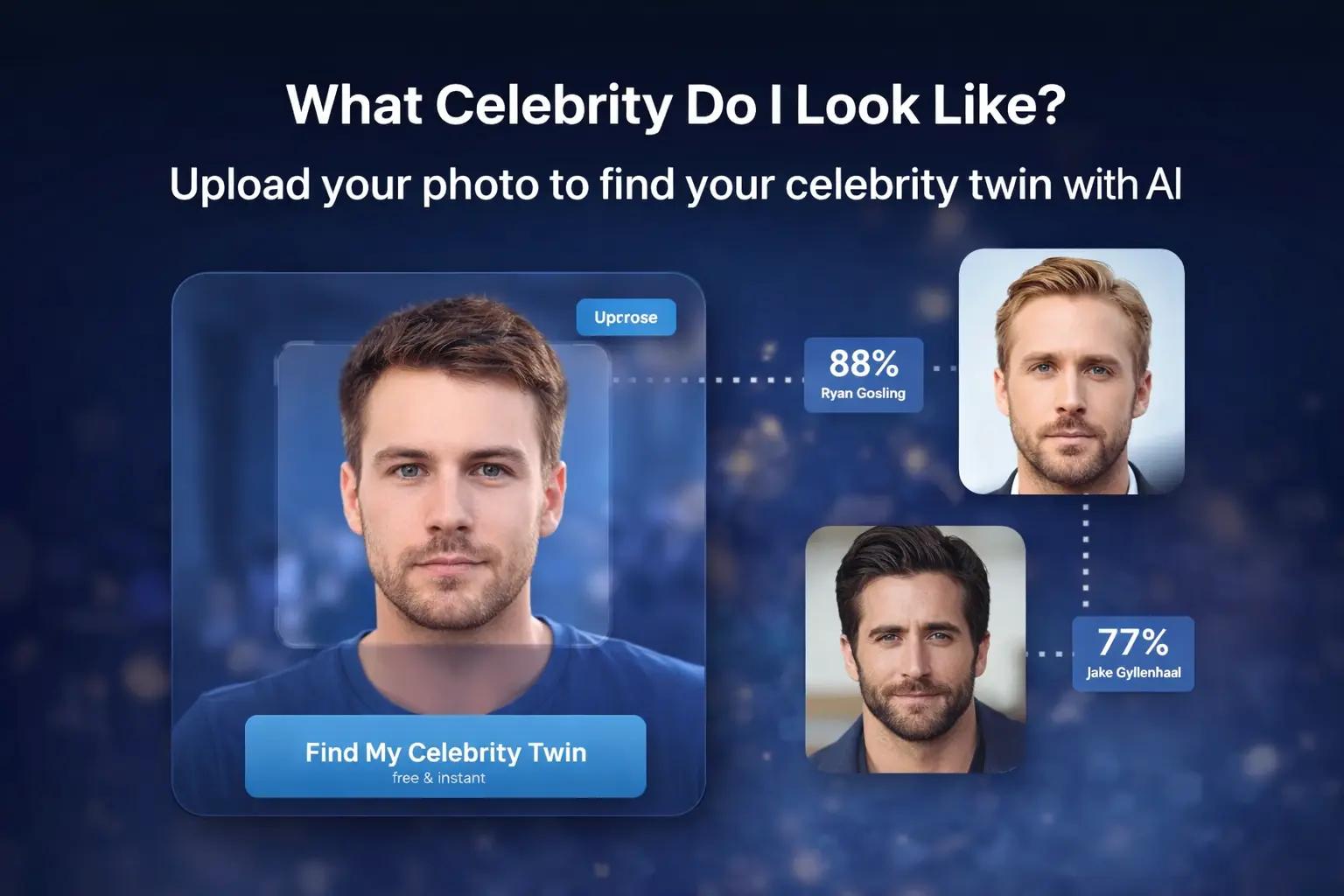
Curious what the machine says about your face? Try the celebrity match tool →Runs in your browser · Nothing uploaded · No account
What the model actually does to your face
It's worth understanding this, because it changes how you read your result. The model isn't magic and it isn't looking at your photo the way a human would.
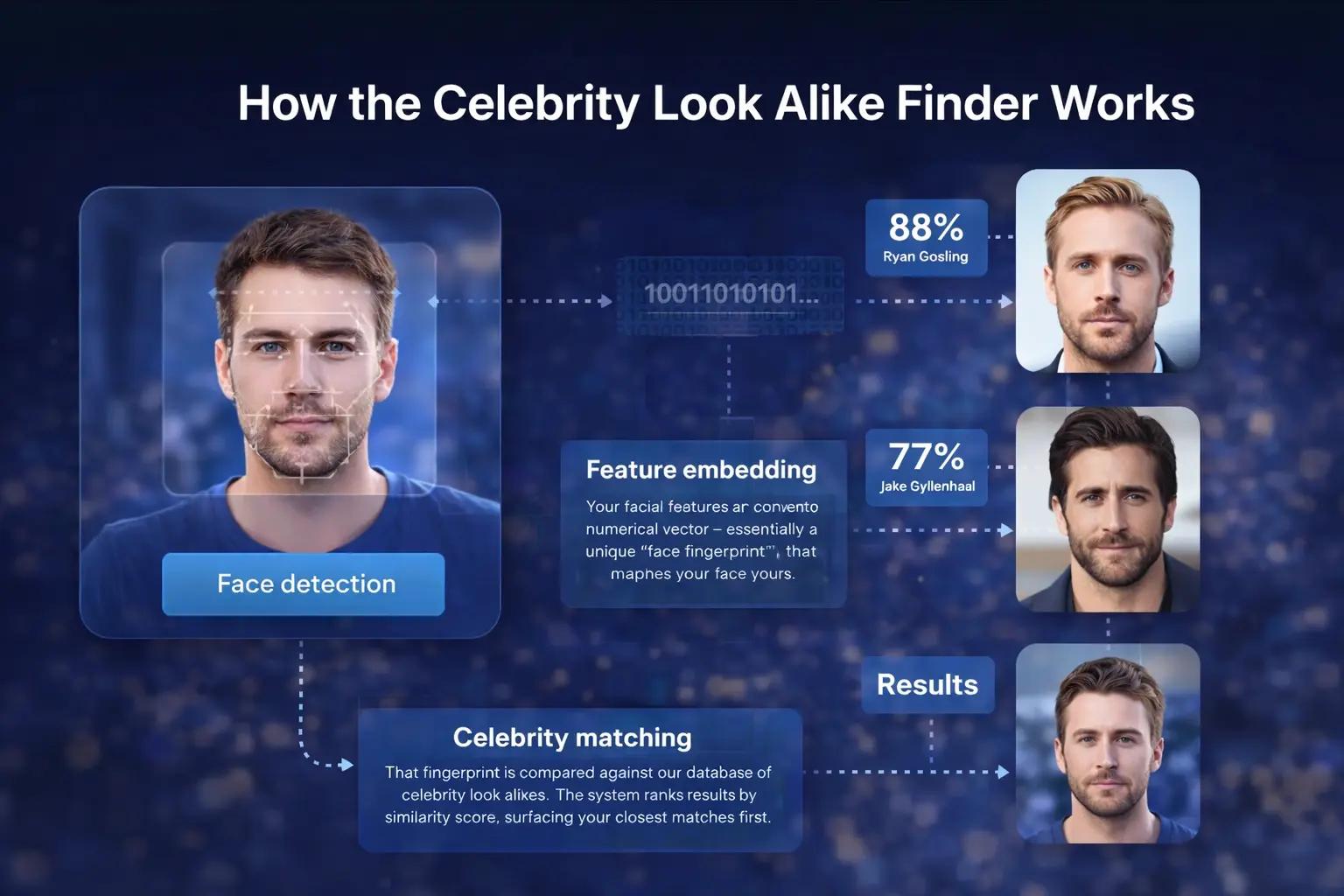
- It places dots on your face. The first thing the model does is find your face in the photo and drop about sixty-eight landmarks on it. Eye corners, eyebrow edges, the tip of your nose, the crease of your lips, the contour of your jaw. If you've ever seen those forensic face-mapping overlays in crime shows, it looks like that.
- It crushes those dots into a number list. Those landmarks get mathematically compressed into an array of a few hundred numbers. Researchers call this an embedding. The numbers encode the geometry of your face, its proportions, the distances between features. The key property: two photos of the same person produce nearby number lists. Two strangers produce lists that sit far apart.
- It measures the gap between you and every celebrity. The model already has number lists for thousands of celebrities, pre-computed and stored. It takes your list and calculates the mathematical distance to each of theirs. Shortest distance wins. Those closest entries become your results.
- The percentage is a distance, not a resemblance score. Here's where most people get confused. That 87% match doesn't mean you look 87% like that celebrity. It means the numerical distance between your embedding and theirs is small relative to a baseline. A high percentage tells you your facial geometry is unusually close to theirs. It does not tell you that anyone on the street would notice the resemblance.
If the result feels wrong, it's probably the photo
The model has nothing to work with except the pixels you give it. Garbage in, garbage out applies here more than anywhere. Here's what actually trips the model up:
- Shadows are the enemy. A lamp casting a hard shadow across half your face changes the distance readings the model uses. Overcast daylight or a room with multiple light sources will give you a cleaner result than direct sun or a single overhead bulb.
- Angle matters more than you'd think. A selfie taken from below makes your jaw look wider and your forehead narrower. The model takes that at face value. Hold the camera at eye level.
- Glasses, hats, and hair across your face all hide landmarks. The model will either hallucinate their positions or skip them, and either way the match degrades.
- Beauty filters are the worst offender. If your selfie has been through a smoothing or reshaping filter, the filter already moved your features around. You're matching the filter's version of your face, not your actual one.
- Try more than one. Different photos will produce different results because the angle and lighting shift the landmark positions. If three photos all point to the same celebrity, that's a strong signal.
The model doesn't know what you look like in person. It only knows the 2D projection in the photo. A good photo is one that looks like you from the front, in flat, even light.
Why we're wired to want this answer
There's a branch of psychology that studies why humans are obsessed with categorizing faces. We can't help it. Show someone a stranger's photo and within milliseconds their brain is sorting that face into buckets: reminds me of my uncle, looks like that actress, has the same vibe as my coworker. It's involuntary and it's ancient. Evolutionarily, being able to quickly sort and recognize faces was a survival skill.
A celebrity look-alike tool takes that instinct and hands it a number. Instead of vaguely thinking you sort of look like someone, you get a specific name and a percentage. That makes it feel more real, more verdict-like. It isn't a verdict. But it's a fun enough proxy that millions of people have tried these tools, and a good chunk of them screenshot the result and send it to a friend.
It has also bled into gaming culture. In Roblox's Dress to Impress and similar avatar-styling games, there's a celebrity look-alike round where you try to recreate a famous person's look. Players who start from an actual face match tend to score higher than players who guess.
How to make sense of what you see on screen
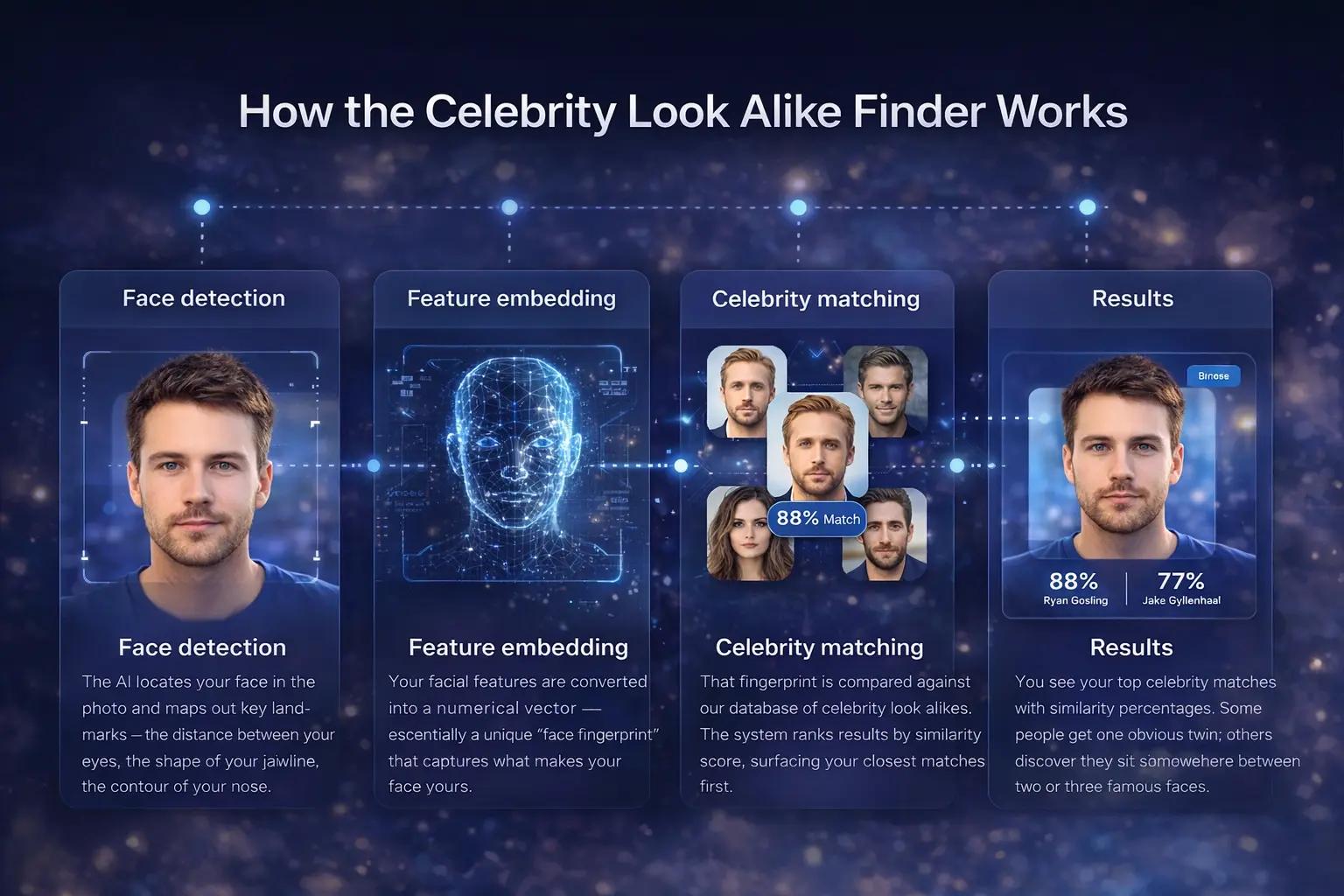
When the results come back, they fall into a few patterns. Knowing which one you're looking at helps you interpret the numbers.
The runaway winner
One celebrity sits at the top with a big gap between them and second place. This feels definitive but isn't necessarily. It means the model is confident about the geometric distance. Whether a human would see the resemblance is a separate question.
Two names neck and neck
Your face sits between two celebrities and the model can't decide. This is actually common and often more interesting. You might genuinely share traits with both. Think of it as your face being a geometric average of two famous people.
The total unknown
Sometimes the top match is an actor from a show you've never watched or a public figure from a country you can't place. The model doesn't care about fame. It's comparing shapes. Whether you look up that person afterward is up to you.
So what celebrity do you look like?
There's only one way to find out what the model says. Drop in a photo, wait a couple of seconds, and see what comes back. Your image gets processed on your own device and disappears when you leave this page. The result is not a scientific verdict on your appearance, it's a geometric party trick that runs entirely on your hardware. See your celebrity match →
Runs locally · Takes about five seconds · No signup
Compare yourself to a specific star. Want to check how you measure up against a particular celebrity? Every person in the library has a breakdown of their facial geometry, the features that define them, and the types of photos that produce good matches against them. Pick someone and run the comparison. Browse the celebrity library →